BLCU Continuing Education College
Chinese Language Education Platform

Sign Up
Log in
BLCU Continuing Education College
Chinese Language Education Platform

The vocabulary requirement has increased significantly:
· HSK 2.0: 2,500 words
· HSK 3.0: 3,600 words
· Increase: +1,100 words
This expanded vocabulary reflects the goal of HSK 3.0 to assess a learner’s ability to function in a wider range of academic, professional, and everyday situations.
Unlike the lower levels, the listening section of HSK 5 remains largely unchanged.

Listen to a dialogue and choose the correct answer.
Listen to a dialogue or short passage, followed by two or three questions, and select the correct answers.
Although the question types remain the same, the increased vocabulary requirement means learners will still need stronger listening comprehension skills to succeed.
The reading section introduces one major change.
The cloze test (fill-in-the-blank passage) remains unchanged.
This section has been completely redesigned.
HSK 2.0:
· Read short passages and answer comprehension questions.
HSK 3.0:
· Arrange the paragraphs of an article into the correct order.
No change. Candidates still read an article and answer questions based on its content.

The new paragraph-ordering task tests a learner’s ability to understand logical connections between paragraphs, identify discourse structure, and follow the development of ideas throughout a text.
The writing section has undergone the most significant transformation.
HSK 2.0:
· Arrange given words into correct sentences.
HSK 3.0:
· Write a short composition of approximately 100 Chinese characters based on four pictures.
HSK 2.0:
· Write two short passages using given words.
HSK 3.0:
· Write a composition of approximately 200 Chinese characters according to the given topic and requirements.
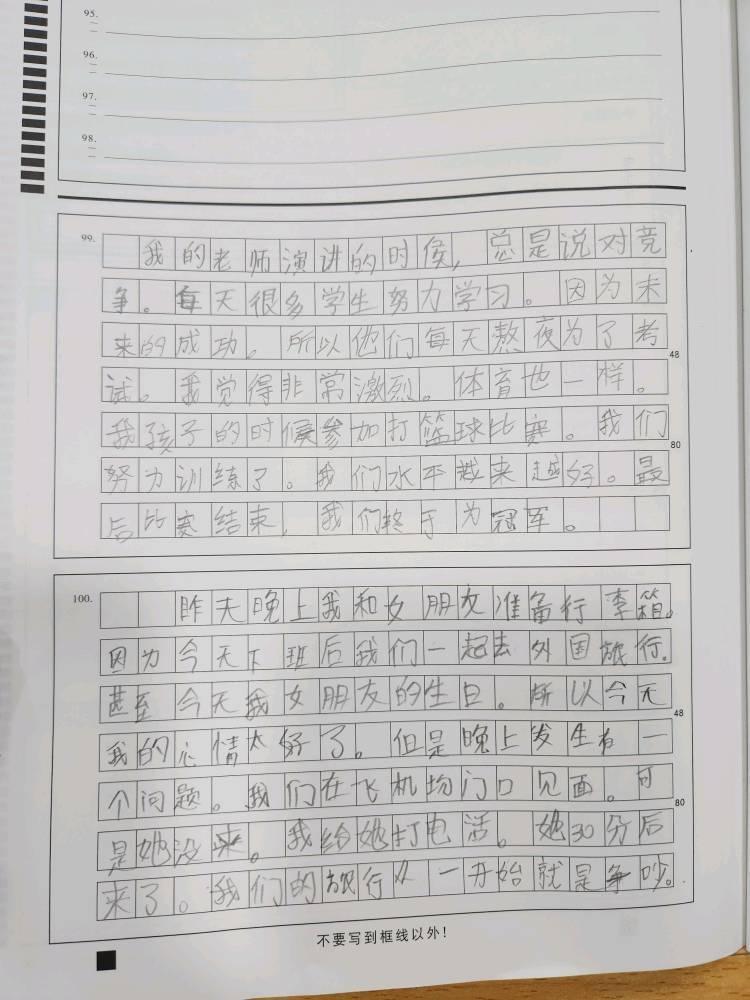
The new writing section focuses far more on:
· Organizing ideas logically
· Developing coherent paragraphs
· Using vocabulary and grammar actively
· Expressing opinions and descriptions in longer texts
The required writing length has roughly doubled, while the overall exam time remains unchanged. As a result, candidates must improve not only their writing ability but also their writing speed.
One of the most important changes is that HSK 5 now has its own dedicated speaking test.
HSK 5 and HSK 6 candidates shared the same HSKK Advanced examination.
A separate HSKK Level 5 speaking test has been introduced.
HSK 2.0:
· Listen to and retell three short passages.
HSK 3.0:
· Listen to and retell two short passages.
HSK 2.0:
· Read a passage aloud.
HSK 3.0:
· Describe a picture using your own words.
No major changes. Candidates still answer two questions based on the prompts provided.
The new speaking test places greater emphasis on spontaneous language production and real communication skills. Instead of simply reading a passage, candidates must now organize and express their own ideas.
At the same time, because HSK 5 candidates no longer share an exam with HSK 6 candidates, they are less likely to encounter vocabulary and topics beyond the HSK 5 syllabus. This makes the test more targeted and arguably fairer for learners at this level.
The overall philosophy of HSK 3.0 becomes very clear at Level 5.
Many of the simpler tasks have been removed:
① Sentence reordering
② Reading aloud
③ Short structured writing tasks
They have been replaced by tasks that require:
① Independent thinking
② Paragraph writing
③ Picture-based expression
④ Real communication skills
The greatest challenge lies in the writing section, where candidates must produce significantly longer and more organized texts within the same amount of time.

Compared with HSK 2.0, HSK 3.0 Level 5 is less about recognizing correct answers and more about actively using Chinese.
To prepare successfully, learners should focus on:
· Expanding vocabulary beyond memorization
· Reading longer texts regularly
· Practicing paragraph and essay writing
· Improving speaking fluency and confidence
· Developing the ability to organize ideas clearly in Chinese
As HSK 3.0 places greater emphasis on writing, speaking, and practical communication, structured guidance becomes more important than ever.
At eBLCU (Beijing Language and Culture University Online Platform), we offer online Chinese courses designed to help learners build the skills needed for both HSK 2.0 and the future HSK 3.0 exams.
Our programs include:
l HSK preparation from Levels 1–6
l Experienced and professional Chinese teachers
l One-on-one and small group classes
l Flexible schedules for learners worldwide
l Training in listening, reading, writing, and speaking
Although our current HSK curriculum is primarily based on the HSK 2.0 framework, it provides a strong foundation that supports a smooth transition to HSK 3.0.
Learn more: https://www.eblcu.com/hsk